This article provides an overview of encoders utilized in variable speed drive systems: in which situations are they needed, on what principle do they work, what are the key parameters of an encoder and what other design options shall be considered when selecting an encoder.
Encoders are electro-mechanical devices that convert rotational motion into electrical signals, providing feedback to the VFD about the motor’s speed and position.
Encoders play a critical role in this process by providing feedback to the VFD, allowing for more accurate motor performance. Encoders measure the position, speed, or rotation of the motor shaft, converting this data into a digital signal that the VFD can interpret.
Fortunately, it’s relatively easy to connect an Encoder to aVFD once you understand the basics. This article will discuss everything you need to know for a successful connection, including understanding the different types of encoders, how to mount them, and which cables to use.
A Variable Frequency Drive (VFD) controls motor speed and torque, but without an encoder, it can only estimate actual performance. Encoders provide critical feedback, enabling closed-loop control.
By adding an encoder to the target motor as a feedback mechanism for speed detection and providing that feedback to the VFD, the VFD controller can tell the precise speed at which the motor is running.
In a VFD system, an encoder provides closed-loop feedback, allowing the VFD to adjust motor speed and torque based on real-time motor behavior. This system continuously monitors the encoder’s position data and compares it to the target motor speed.
Motor’s don’t always spin at the same rate as its rotating field, particularly when it is under mechanical load. This is called slip. An optical rotary encoder is used as a tachometer to adjust voltage and frequency, especially when a constant RPM is desired with a variable load.
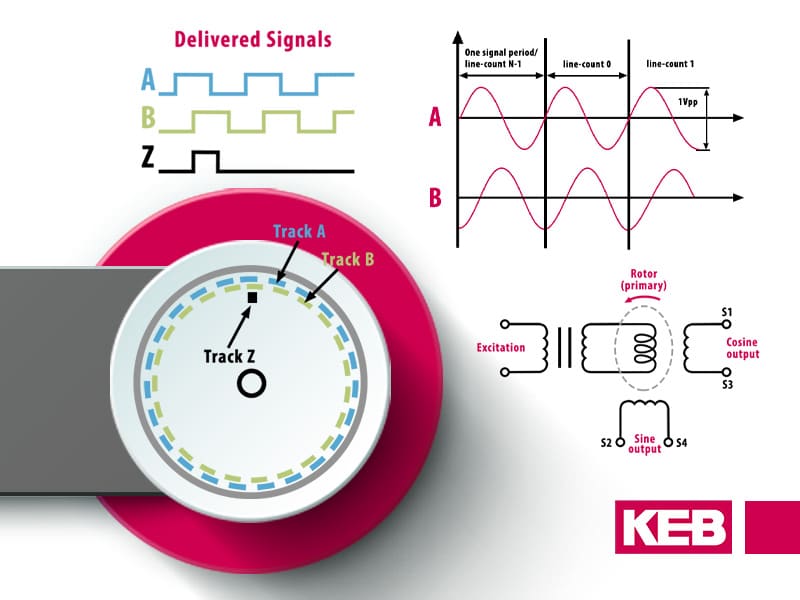 In a VFD system, an encoder provides closed-loop feedback, allowing the VFD to adjust motor speed and torque based on real-time motor behavior. This system continuously monitors the encoder’s position data and compares it to the target motor speed.